Friday, April 26, 2013

You Always Seem About to Pay

pollicitis dives quilibet esse potest - Ovid, Ars Amatoria I.444
"Anyone can be rich in promises." (lit. "things promised")

In this section of the Ars Amatoria, Ovid advises the prospective lovers how to avoid spending  money on gifts for their girlfriends. He advises they promise to give gifts, that way they don't have to actually give anything. As he puts it:

at quod non dederis, semper videare daturus:
  sic dominum sterilis saepe fefellit ager.
- I.449-450
"But that which you haven't given, may you always seem about to give:
Thus has a barren field often deceived its master."

So, naturally, I thought of Credit Cards. 

Gospel Troopers?

Mark "Suddenly!"
Luke "Parable!"
John "Verily verily!"
Matthew "Blessed!"

The Four Evangelists and their standard heraldic symbols (Mark=lion, Luke=bull/ox, John=eagle, and Matthew=holy man/angel) as a kind of Power Rangers team, each with their own catch-phrases.

Mark uses the word for "suddenly" or "immediately" a lot, so that's his catch-phrase. Luke has perhaps the greatest number of Jesus' parables. John stubbornly writes "Verily, verily" instead of just one "verily" when Jesus says "Verily I say to you." Matthew is notable for the Beatitudes. 

Wednesday, April 24, 2013

Feed My Fish

"Simon, feed also my fish. Not more than enough. Also walk with my dog."
RE: John 21:15-17

Near the end of John's Gospel, Jesus instructs Peter three times to "Feed my sheep." If it were literal we might add more animals to take care of. 

Tuesday, April 23, 2013

Doubting Thomas and Beach Fish Fry

Left: "Who am I?" Right (Apron): "Kiss the Cook"
RE: John 20:24 - 21:14

My take on the famous "Doubting Thomas" incident in the Gospel of John (Left), and on Christ's subsequent appearance to the disciples at the Sea of Galilee (Tiberias) and the miracle of the fishes (Right). It was like a beach fish fry celebrating the Resurrection. 

Saturday, April 20, 2013

So You Want to be a Roman Poet?

"So you want to be a Roman Poet?"
"Get reading, boy. The more obscure the better!"

My gosh, how I hate the ultra-learned poems we have to read sometimes. Just some poet showing off how well he knows the myths to the Nth degree--mentioning obscure places in Greece and obscure people that you  have to use the BIG dictionary to find. We get it, you're very smart. Now shut up. 

Corrigenda: A Latin professor here pointed out that it would be better to say "fieri" ("to become") rather than "esse" ("to be"). Also he suggested "quo ... quo" instead of "quantum...tantum" and that there might be a better word choice than "melius." 

Friday, April 19, 2013

Put-Upon Pilate

RE: John 18:28-40; 19:16-22

The Roman Governor of Judaea, Pontius Pilate, is having a hard week. It's Passover and the local Jewish population are more riled up than usual. They bring him this Jesus fellow to have him put to death, but they won't tell him what Jesus did and they won't even come inside the Praetorium because it would make them "unclean" for Passover. So Pilate has to go back and forth between the high-priests outside the Praetorium and Jesus in his cell inside. Jesus denies being the King of the Jews and then goes into some theological stuff about preaching the truth. Despite his efforts, Pontius has to give in to the demands of the high-priests and crucify the man. Then, on top of everything, they start complaining about the sign he put up. 

Oy vey! 

Thursday, April 11, 2013

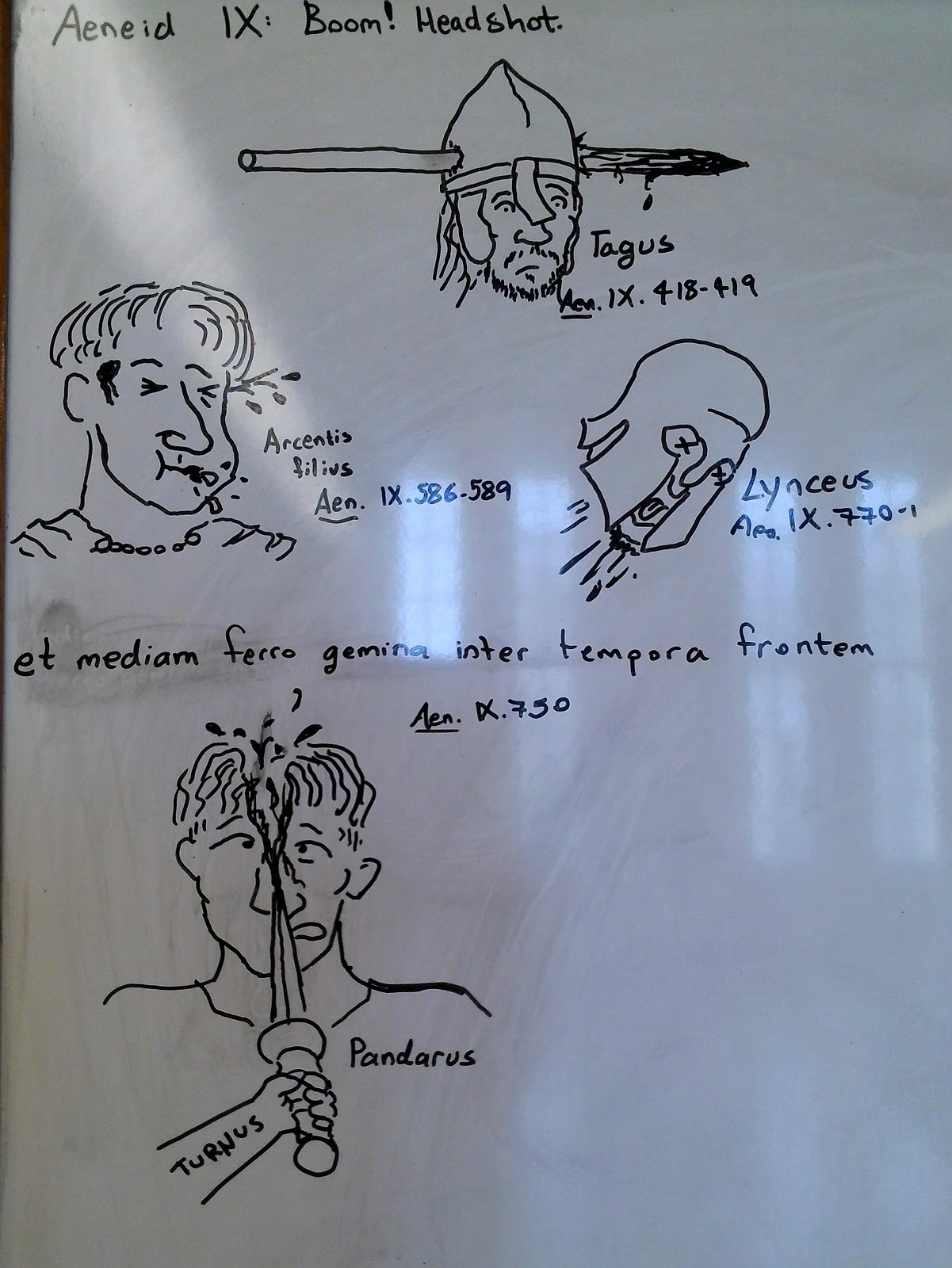
Boom! Headshot.

RE: Vergil, Aeneid IX 

So, I finished reading Aeneid book IX today, and I have to say, there were an awful lot of headshots in this book. Four of them, I think, which I have summarized above with the appropriate textual references. 

  1. Tagus, an Italian, is pierced through the head by a spear thrown by Nisus
  2. the son of Arcens (whose name we don't learn), gets a sling bullet to the head from Mezentius
  3. Lyceus has his head chopped off by Turnus
  4. Pandarus has his head sliced in two by the same. 


Vergil uses a wonderfully illustrative line for that:
      "et mediam ferro gemina inter tempora frontem"
It's a golden line (or silver?) nicely divided, like Pandarus' head, in the middle by "inter."